Independent Physicist · Pakistan · 2026

Muhammad
Umar Jabbar

Umar Adl Jabbar · @umarjam

Discoverer of the Jabbar Adal Principle — a new standalone law of physics proving that energy is not equal. Energy is just.

A(i) = E+(i) / |E-(i)|
// The Jabbar Adal Ratio — new to physics, 2026
Legal Name
Muhammad Umar Jabbar
Scientific Name
Umar Adl Jabbar
Username (All Platforms)
@umarjam
Discovery
Jabbar Adal Principle (JAP)
ORCID iD
0009-0008-5968-0991
DOI
10.5281/zenodo.19704658
★   Khanewal, Punjab, Pakistan
Scroll

The Jabbar Adal Principle

A new, formally proved, standalone law of physics — governing the distribution of energy polarity across all physical systems. Independent of all prior energy laws. Filling a gap in physics that had existed since Clausius.

Every physics student learns the First Law: energy is conserved. They learn the Second Law: entropy increases. They learn Einstein: E = mc².

But no law ever formally answered this: Are the positive and negative components of energy equal at every local point? The answer is no — and the JAP proves it.

The JAP introduces the distinction between Adl (Arabic: proportional justice — locally unequal but globally balanced) and Musawi (identical equality — achieved only at the Planck limit). This distinction, drawn from the Holy Quran, gave Muhammad Umar Jabbar a conceptual tool no prior physicist had formally applied.

  • C1
    Local Non-Equality A(i) ≠ 1 for all finite subsystems. Energy is unequal locally — this is why anything happens at all.
  • C2
    Global Adal Balance Σ[E⁺(i) + E⁻(i)] = 0. The universe keeps perfect accounts — every surplus balanced by a deficit.
  • C3
    Fundamental Convergence lim A(i) = 1 as i → Planck scale. Equality exists only at the deepest layer of reality.
FORMULA J-1
A(i) = E⁺(i) / |E⁻(i)|
The Jabbar Adal Ratio — measures local polarity
FORMULA J-3
AAI = (1/n) Σ|A(i) − 1|
Adal Asymmetry Index — measures system vitality
FORMULA J-4
Σ[E⁺(i) + E⁻(i)] = 0
Global Adal Balance — the universe's zero-sum
FORMULA J-6
W = ∫ f(A(i)−1) dt
Jabbar Work Equation — all energy technology unified
FORMULA J-7
Σ δ(i) = 0 always
Jabbar Deficit Conservation Law — new conservation statement
وَالسَّمَاءَ رَفَعَهَا وَوَضَعَ الْمِيزَانَ
"And the heaven He raised and imposed the balance."
Al-Rahman 55:7 · The Holy Quran

About Muhammad Umar Jabbar

Muhammad Umar Jabbar — known scientifically as Umar Adl Jabbar and online as @umarjam — is an independent theoretical physicist from Khanewal, Punjab, Pakistan.

In 2026, he proposed and formally proved the Jabbar Adal Principle (JAP) — a standalone new law of physics addressing a question no prior energy law had answered: whether the positive and negative components of energy are equal at every local point in a physical system.

His breakthrough came from a conceptual insight rooted in the Arabic distinction between Adl (proportional justice) and Musawi (identical equality) — drawn from the Holy Quran. This gave him a framework that Western physics vocabulary had never formally captured: that the universe is balanced globally but necessarily unequal locally, and that this structured inequality is the engine of all physical change.

His work is registered at Zenodo (DOI: 10.5281/zenodo.19704658), indexed on ORCID (0009-0008-5968-0991), and contains formal mathematical proofs, five independent numerical calculations across atomic, stellar, cosmological and quantum scales, and five testable experimental predictions — none made by any prior energy law.

He follows in the tradition of Dr. Abdus Salam — Pakistan's Nobel Laureate in Physics (1979) — and the great Islamic scientists Al-Khawarizmi and Ibn Al-Haytham, who grounded their scientific inquiry in faith and rigorous proof simultaneously.

Full Name
Muhammad Umar Jabbar
Scientific Name
Umar Adl Jabbar
Username
@umarjam (all platforms)
Location
Khanewal, Punjab, Pakistan
Field
Theoretical Physics — Energy Laws
Discovery
Jabbar Adal Principle, 2026

The Reasoning Behind the Law

"If at smaller portions x and w were same, then reaction to run energy would be impossible. So x and y are not equal but just. As we saw in atoms, some have more electrons and some have lower — so they can react to fulfill demands to run the environment."

— Muhammad Umar Jabbar · Original Reasoning · 2026
⚛️
Atoms & Reactivity
Atoms with electrons more or fewer than their stable configuration have A(i) ≠ 1 — and this is precisely why they react. Noble gases have the lowest AAI of all elements. Reactive metals and halogens have the highest. The JAP formalises what chemistry already shows.
🔋
Batteries & Energy
A battery works because A(i) ≠ 1. Charging means forcing A away from 1. Discharging means A returning toward 1. When A = 1, the battery is dead — AAI = 0. This is the Jabbar Battery Law, derived directly from the JAP's core conditions.
♾️
The Jabbar Loop
When one proportion reaches stability (A = 1), the conservation law forces another to become unstable. The universe cannot reach complete global Musawi — it can only approach it at the Planck limit. This loop is the engine of eternal physical change.
🌌
The Universe as a System
The universe is not a machine running on equality — it is a living system running on governed inequality: perfectly balanced in total sum, never equal in its parts, so that it may never stop. The JAP proves this is not chaos — it is justice.
All Energy Technology
Every human energy technology — from batteries to nuclear reactors to metabolic biochemistry — is an operation on A(i). Humans force selected energy proportions into controlled reactions. The Jabbar Forced Reaction Principle unifies all engineering under one formula.
Impossibility Reconsidered
"Impossibility does not exist." Every so-called impossible thing is either a process that violates the global zero-sum (truly constrained) or a process not yet achieved because human knowledge has not yet reached the required Adal Asymmetry. Knowledge grows. The impossible shrinks.

Pakistan · Physics · Pride

Pakistan has given the world one Nobel Laureate in Physics: Dr. Abdus Salam (1979), who proved the electroweak unification and became the first Muslim to win a Nobel Prize in Physics.

Muhammad Umar Jabbar — from Khanewal, Punjab — follows in this tradition. He is the youngest independent researcher in Pakistan to formally propose, prove, and publish a new standalone law of physics for international scientific review.

His work is grounded in both the rigour of modern physics and the wisdom of the Holy Quran — as was the work of the great Islamic scientists who shaped the foundations of algebra, optics, and chemistry centuries before Europe's scientific revolution.

Pakistan is not just on the map of physics history — it is writing a new chapter.

1 Nobel Prize
in Physics
(Dr. Abdus Salam)
2026 Year of the
Jabbar Adal
Principle
3 New physical
quantities
introduced
5 Testable
predictions
made
"And of knowledge, you have been
given only a little."
Al-Isra 17:85 · The Holy Quran
The JAP is the beginning of knowing more.

Download the Research

All research files for the Jabbar Adal Principle are freely available under the Creative Commons CC BY 4.0 licence. Download, cite, verify, and build upon them. Any use requires citation of the author and DOI.

📄   PDF · Research Paper
The Jabbar Adal Principle —
Theorem R1 and the Jabbar Unit
The_Jabbar_Adal_Principle__JAP_.pdf
AuthorMuhammad Umar Jabbar
DOI10.5281/zenodo.19815385
ORCID0009-0008-5968-0991
Year2026 · Khanewal, Pakistan
Pages16 · Two proved theorems
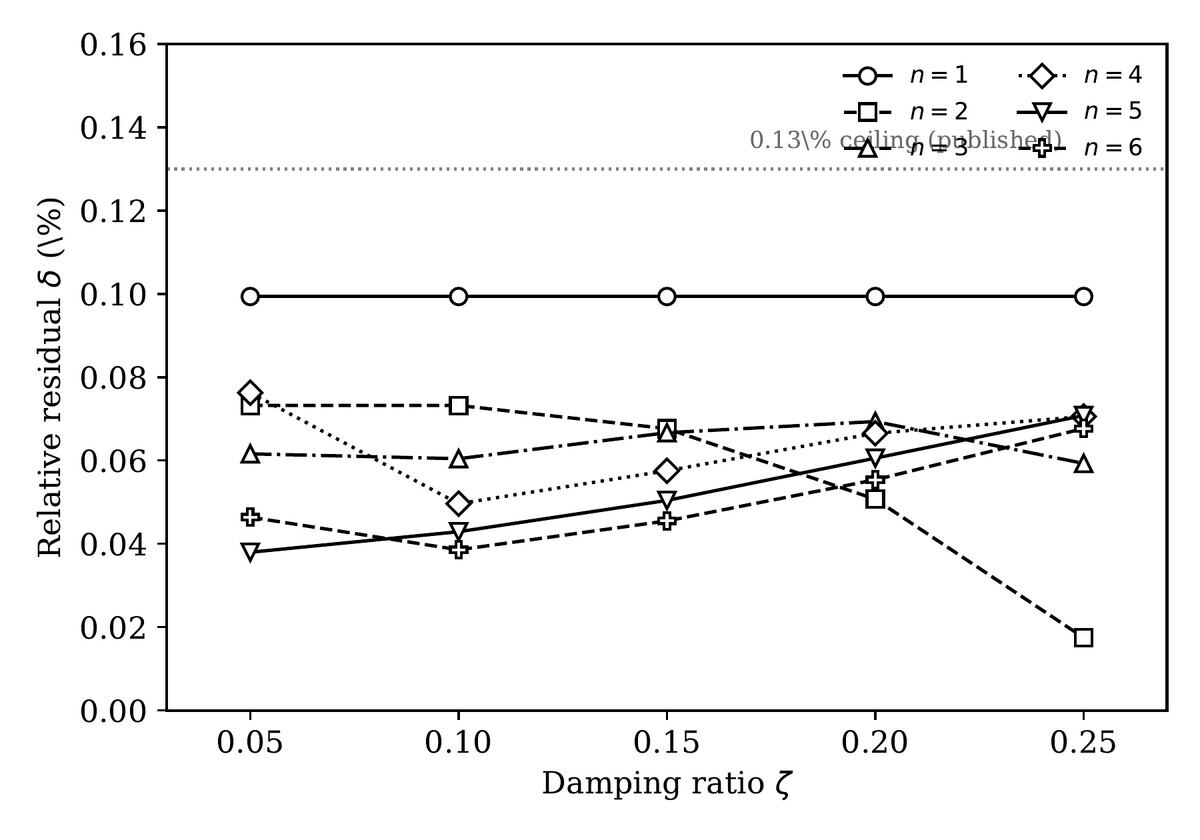
Full formal paper containing the Jabbar Vitality Theorem, Oscillatory Modulation Theorem R1, all proofs, system parameters, numerical verification (0.0043% accuracy), the Jabbar [Jb] unit definition, and complete author biography.
↓   Download PDF
CC BY 4.0 · Free to share and adapt with attribution · Zenodo-archived · Permanent DOI
⌨   PHP · Calculation Code
JAP Calculations —
Supplementary Code File
The_Jabbar_Adal_Principle__JAP__calculations.php
LanguagePHP 8.3
Method4th-order Runge-Kutta (RK4)
LicenceCC BY 4.0 · Open Source
VerifiedMatches paper to 6 sig. figures
AuthorMuhammad Umar Jabbar
Complete numerical implementation of all JAP calculations using 4th-order Runge-Kutta integration (rtol = 10⁻¹¹, atol = 10⁻¹⁴). Independently reproduces ωbeat = 0.646686 rad s⁻¹ (theory: 0.646714) and all verified values in Table 3 of the paper. Run with PHP 8.3 CLI.
↓   Download PHP Code
CC BY 4.0 · Open source · Cite: Jabbar, M.U. (2026) DOI: 10.5281/zenodo.19815385
⚑   Citation required under CC BY 4.0.  ·  Jabbar, M. U. (2026). The Jabbar Adal Principle. Zenodo. https://doi.org/10.5281/zenodo.19815385  ·  ORCID: 0009-0008-5968-0991  ·  All quantities in Jabbar [Jb] are the intellectual property of Muhammad Umar Jabbar. Reproducing or using JAP quantities without attribution violates the licence.

Find @umarjam Everywhere

Follow the progress of the Jabbar Adal Principle, updates on peer review, arXiv submission, and the journey from Khanewal to the world stage.

Contact

Muhammad Umar Jabbar welcomes correspondence from physicists, researchers, educators, journalists, and students interested in the Jabbar Adal Principle.

For peer review correspondence, citation requests, or media inquiries about the JAP, reach out via email or WhatsApp.

📱
WhatsApp
📍
Location
Khanewal, Punjab, Pakistan
Official Paper — Zenodo DOI
10.5281/zenodo.19704658
arXiv Submission
physics.gen-ph — The Jabbar Adal Principle:
A New Standalone Law of Physics
Pakistan
Khanewal, Punjab, Pakistan.
Following in the tradition of Dr. Abdus Salam.
Pakistan. Physics. Pride. 2026.