⌨️

Keyboard Shortcuts

Φ(t₀, τ) = |Σ_α w_α I_C(α, t₀, τ)| / [I_E(t₀, τ) · Σ_α w_α] I_E(t₀,τ) = [e^{−γt₀} − e^{−γ(t₀+τ)}] / (γτ) H = Σ p²/2m + ½Σ k_ij(q_i−q_j)² ⟨T⟩ = −½⟨Σ r_i · F_i⟩ Ω = Σ_α ω_α · w_α / Σ w_α

Key Equations

TRVIT Theorem 3.1:

$$\Phi(t_0,\tau) = \frac{|\sum_\alpha w_\alpha I_C(\alpha, t_0, \tau)|}{I_E(t_0, \tau) \cdot \sum_\alpha w_\alpha}$$

Energy Decay:

$$I_E(t_0,\tau) = \frac{e^{-\gamma t_0} - e^{-\gamma(t_0+\tau)}}{\gamma\tau}$$

Hamiltonian:

$$H = \sum \frac{p^2}{2m} + \frac{1}{2}\sum k_{ij}(q_i-q_j)^2$$

Virial (Clausius 1870):

$$\langle T \rangle = -\frac{1}{2}\langle \sum r_i \cdot F_i \rangle$$

GOMT Scalar:

$$\Omega = \frac{\sum_\alpha \omega_\alpha \cdot w_\alpha}{\sum w_\alpha}$$
New Preprint Submitted to Physica Scripta Double-Blind Review

Exact Modified Virial Identity for Driven-Damped Non-Harmonic Oscillators in Non-Equilibrium Steady States

Author list removed for double-blind review · Submitted to Physica Scripta

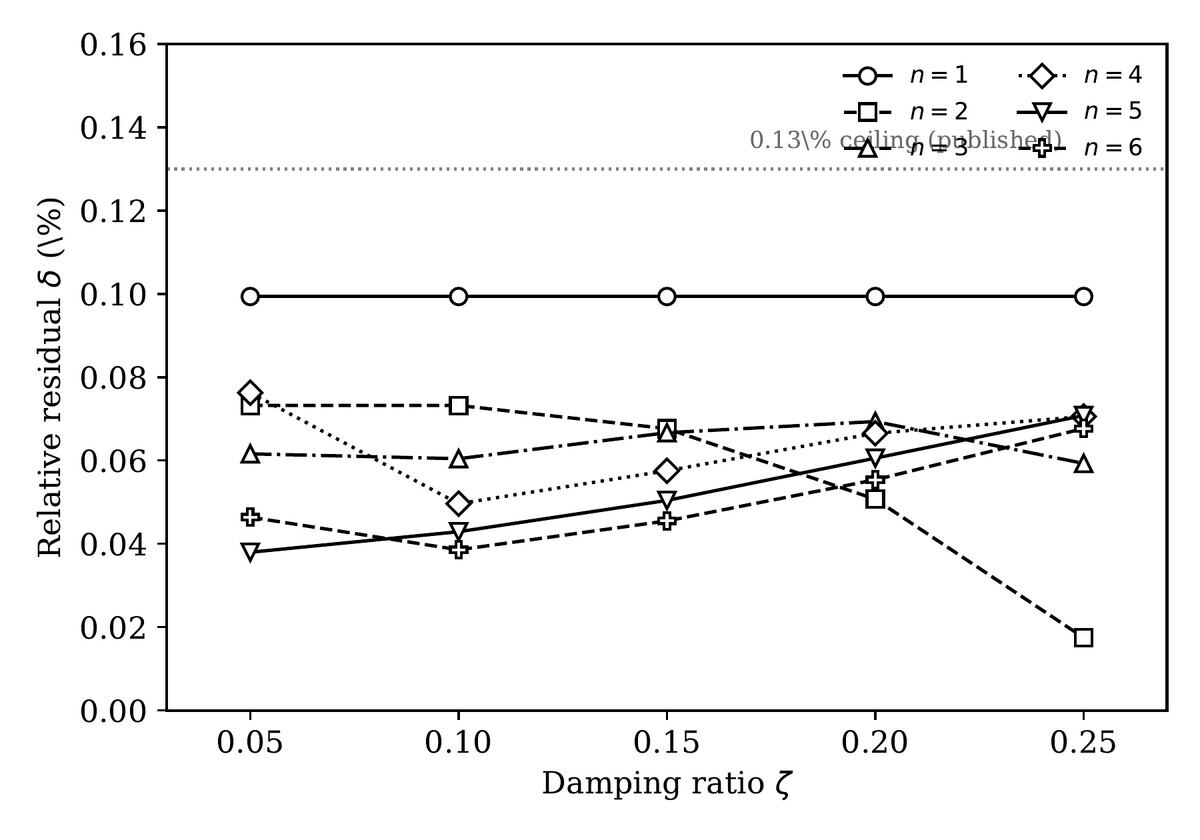
The classical virial theorem holds only for conservative power-law potentials; it breaks down once damping and periodic forcing enter, as in almost every real driven oscillator. This paper derives an exact identity for the time-averaged energy partition of a periodically driven, linearly damped, non-harmonic oscillator in its non-equilibrium steady state (NESS), adding a damping cross-correlation term and a forcing cross-correlation term to the classical result. The identity is verified by adaptive eighth-order Runge–Kutta integration (SciPy DOP853) across thirty independent parameter combinations, with residuals below 0.13% — consistent with floating-point precision. The two correction terms define a measurable scalar, the virial defect Δ, computable directly from a single time series without knowledge of the potential's coefficients.
#VirialTheorem #ClassicalMechanics #NonlinearDynamics #DuffingOscillator #NonEquilibriumPhysics #DampedOscillator #TheoreticalPhysics #ComputationalPhysics #Physics #OpenScience
Figure 1: relative residual δ between the two sides of the modified virial identity as a function of damping ratio ζ, for nonlinear exponents n = 1 through 6
Fig. 1 — Relative residual δ vs. damping ratio ζ across n ∈ {1,…,6}. All 30 combinations stay below the 0.13% ceiling, independently re-implemented.
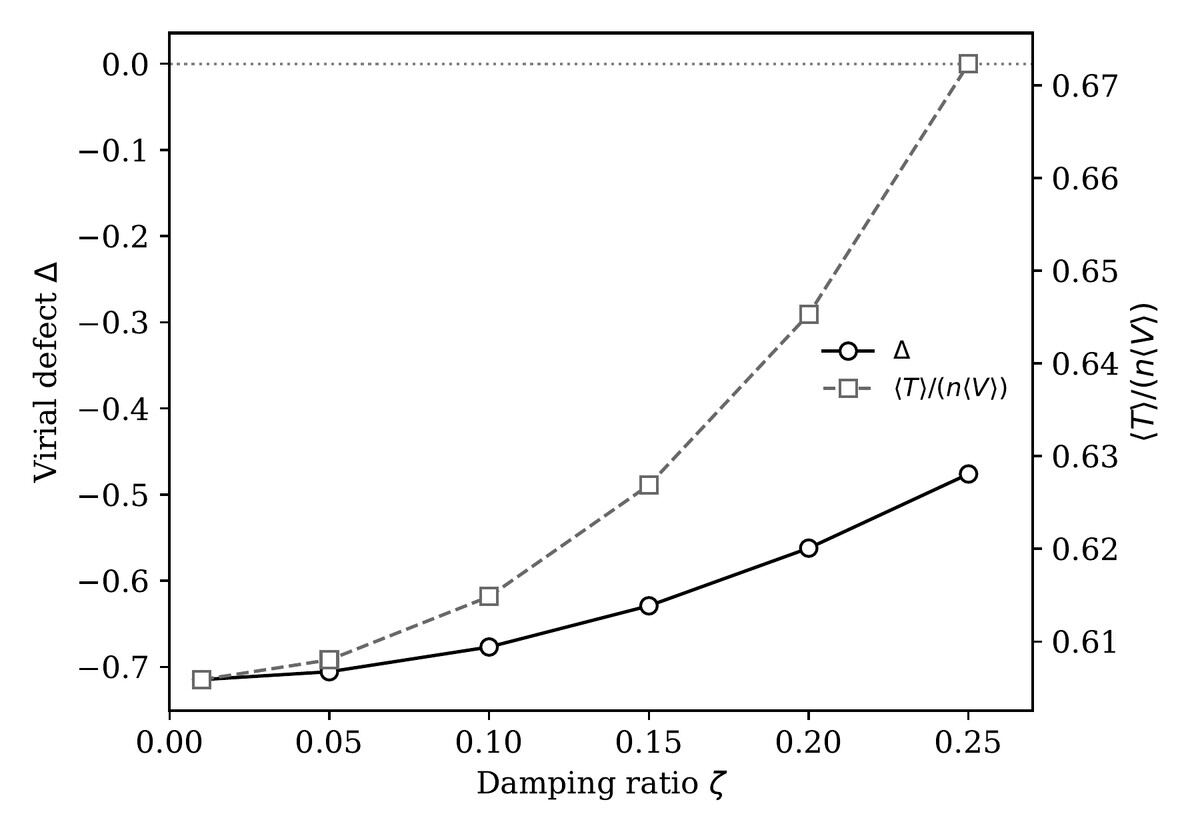
Figure 2: virial defect and normalized kinetic-energy fraction versus damping ratio for the Duffing case n = 2
Fig. 2 — Virial defect Δ and ⟨T⟩/(n⟨V⟩) vs. ζ for the Duffing case (n = 2). Stronger damping pulls the NESS toward classical equipartition.

The Modified Virial Identity

$$2\langle T\rangle = 2n\langle V\rangle + 2\zeta\langle x\dot x\rangle - \langle x\cos(\Omega t)\rangle$$

The Virial Defect

$$\Delta \equiv 2\zeta\langle x\dot x\rangle - \langle x\cos(\Omega t)\rangle$$
<0.13%Max Residual
30Parameter Sets
n=1…6Nonlinearity Range

Share This Result